
|
A positive resolution of this issue depends on individual people getting involved and taking action. Even if you don't live in Cayuga Heights, you can make a difference:
1. Speak up
Contact the following decision makers and let them know your questions and concerns:
Mayor Kate Supron
(607) 257-1238
email
Deputy Mayor Liz Karns
(607) 257-1238
email
Police Chief James Steinmetz
(607) 257-1011
email
Cayuga Heights Trustees:
Chris Crooker email
Stephen Hamilton email
Diana Riesman email
Richard Robinson email
Peter Salton email
Phone messages for the trustees can be left at (607) 257-1238.
2. Sign our online petition
Visit Change.org for a quick and easy way to get your name added to our petition and have an email sent in your name to the decisionmakers.
3. Write a letter to the editor
The Ithaca Journal
Ithaca Times
Cornell Daily Sun
4. Sign up to receive updates
Sign up at the top of this column.
5. Help educate others
Get your friends, neighbors and colleagues involved in the public dialogue about this important issue. Begin by letting them know about this web resource. You can do that quickly and easily by clicking on the Send-to-a-Friend button.
6. Attend meetings of the Cayuga Heights Village Trustees
The Village Trustees are the decision makers. Consider attending these public meetings and letting the trustees know your questions and concerns.
Village Trustee meetings are open to the public and are held at 7 PM on the second Monday of every month.
|
|
|
Learn more | What you can do | Sign our Online Petition
| |
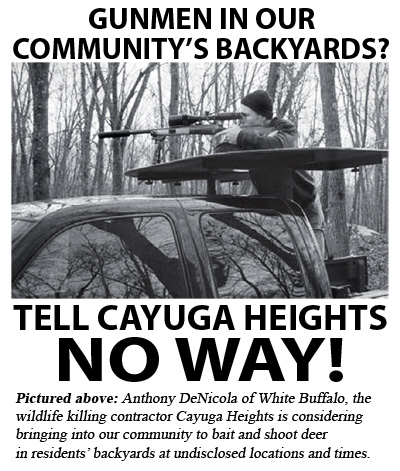
Thus far, the arguments presented to support a deer killing program have been largely unsubstantiated, and have proven to be especially weak when examined in light of data specific to Cayuga Heights. Here are a few examples:
|
Killing deer to prevent Lyme disease?
The incidence of Lyme disease in Tompkins County is low, as much as 10-20 times lower than some other New York counties.1 Of the small number of cases identified here, at least some are believed to be contracted by people traveling outside our region.2 None of the Lyme disease data from our county is linked specifically to Cayuga Heights.3
People don’t catch Lyme disease from deer, but from ticks. Neither the Tompkins County Health Dept. nor the American Lyme Disease Foundation support the killing of deer as a route to reducing Lyme disease risk. In fact, a recent study in New Jersey showed that after three years of an aggressive deer killing program, no reduction in Lyme disease rates or in disease-carrying tick populations were found.4 | |
|
 |
| |
Instead, the Tompkins County Health Dept. focuses on tick bite prevention and identification, as well as diagnostic training for local medical professionals. They stress keeping lawns regularly mowed and removing brush piles. This helps eliminate habitats for ticks and their small animal hosts, such as birds and field mice, which, unlike the deer, are capable of contracting Lyme disease and passing it on to more ticks. In fact, a 2006 study found that the density and infectiousness of ticks can actually INCREASE when deer numbers are suddenly reduced in an area, since ticks then turn to smaller animal hosts, creating tick-borne disease “hot spots.”5
Collision rates: a sign of deer population spiraling out of control?
Deer-Vehicle Collisions
in Cayuga Heights
2008 - 7
2007 - 12
2006 - 11
2005 - 8
2004 - 10 |
|
There is no data demonstrating that the deer population in Cayuga Heights is spiralling out of control, bringing with it more and more deer-vehicle collisions (DVC’s). In fact, the village police reported 7 confirmed DVC’s in 2008, down from 12 in 2007, and 11 in 2006.6 In 2001, a report by Cornell’s Department of Natural Resources found that the rate of DVC’s in Cayuga Heights had been approximately 10 per year for the previous six years.7 So, for more than fifteen years now, the rate of DVC’s has been remarkably stable.
To keep things in perspective, no DVC in recent years has resulted in serious human injury, likely due to Cayuga Heights’ relatively low speed limit. Most fatalities from DVC’s
nationwide happen in speed zones of 55 mph or higher, when the victims are not wearing seat belts or motorcycle helmets.8
Insurance reports have shown that DVC’s spike 300-400% in some communities on the first weekend of hunting season,9 likely due to startled and injured deer scattering into nearby
roadways. This could explain why DVC’s sometimes actually increase after bait-and-shoot programs are implemented.10
Biodiversity and bird populations at risk?
Bait-and-shoot proponents have claimed that the deer are destroying the environment and decimating bird populations in Cayuga Heights. However, when contacted, neither the National Audubon Society nor Cornell’s Lab of Ornithology knew of any documentation of bird species being adversely affected by the presence of deer in the village.11
Recent studies at Ohio State University found that the presence of deer is actually helpful to other animal species, and that programs to reduce their populations may be detrimental to a region’s biodiversity. “Culling deer may cascade into affecting plants, salamanders and other creatures in ways we can’t even imagine,” said OSU researcher Katherine Greenwald. “Officials need to know more about the forest ecosystem before making decisions about wildlife management.”12 Another study showed that some forest
understory-dwelling birds benefit from deer-grazing, and that the presence of deer decreased populations of rodents that preyed on ground birds’ nests.13
Donated venison will help those in need?
Few people realize that venison obtained from deer killing programs is exempt from USDA inspection, and is not necessarily safe. Venison from Irondequoit, NY’s bait-and-shoot program, donated to Attica prison, was deemed unfit for human consumption and discarded.14 The EPA states, “While it may seem that hunting your own game, catching your own fish, or gathering wild plant foods would reduce your overall exposure to pesticides, that isn’t necessarily true. If you eat wild animals or plants from areas where pesticides are frequently used, this food may contain pesticide residues.”15
Deer meat from a bait-and-shoot program is also likely to contain lead from the bullets used. Lead is a potent neurotoxin, and there is no safe level of exposure. It causes neurological,
gastrointestinal and reproductive disorders, and can potentially cause brain damage or death in children that consume even small amounts.16 North Dakota, Minnesota and Wisconsin recently discarded thousands of pounds of donated venison due to the discovery of lead contamination.17 Dr. William Cornatzer, a medical researcher at the University of North Dakota, found lead in 60% of samples of ground venison that had been donated to food programs.18
|
| |
|
| |
A bait-and-shoot program will use valuable tax dollars to bring contracted deer killers into our community year after year. Other communities that have gone down this path have experienced turmoil and division, with local law enforcement officers placed in the middle, forced to provide security for shooters not under their command, in a setting where the killing of human-habituated animals provoked deep upset and anger. While it’s still unclear how a bait-and-shoot program would be carried out here, residents in other communities have described these programs as resembling military operations, with helicopter fly-overs and armed men taking over their public spaces.19
In Irondequoit, NY, where a deer killing program was implemented, resident Sandy Baker reported that wounded and bleeding deer wandered into people’s yards, traumatizing children. “Best friends don’t even talk to each other anymore,” she said at a 2001 public meeting in Cayuga Heights. “The killing programs are the ones that have polarized the community... All I can say is please try to resist any kill program.”
Does it make sense to undertake an expensive, risk-laden program that some residents feel will be a violation of their values, and even traumatic?
In a 2001 survey, only 15-30% of Cayuga Heights residents said they’d approve of a deer killing program.20 And at recent public meetings, the vast majority of citizens speaking out have been vigorously opposed to killing deer. These numbers will only grow if a bait-and-shoot program gets put into place and people begin to witness firsthand the reality of a systematic killing operation.
In fact, a bait-and-shoot program in Rochester Hills, Michigan, was recently cancelled after only one month, due to overwhelming citizen protest. One Councilman said, “The solution has become worse than the problem.”21 Another commented on the rush to cull, saying “Let’s learn something from this, and not ever do anything like this again.”22 |
| |
|
| |
Wildlife biologists and hunters know that killing deer does not necessarily lead to reduction in the size of a herd.23 Whenever there’s an abrupt, short-term drop in the deer population, as would occur following a bait-and-shoot operation, a phenomenon called “compensatory rebound” comes into effect. Since the same amount of food is now available to a smaller number of animals, the bodies of the deer react by becoming more fertile, with more incidences of twin and triplet fawns, and with yearlings going into estrus early.24 This can actually lead to an even greater population of deer the following year.25
So, wherever culling programs are implemented, the killing itself creates the need for even more killing, which must be maintained year after year after year, at great expense to tax-payers. In Princeton, New Jersey, a proposed 5-year program has now been going on for nine years straight. In Solon, Ohio, a proposed 2-year program is currently in its 5th year. In fact, some bait-and-shoot programs have ended not when the deer population reached a desired level, but when the municipalities implementing the programs could no longer afford them, leaving them back where they started, only now considerably
poorer.26
Unlike many other communities implementing bait-and-shoot programs, Cayuga Heights has very few potential sites that are far enough from human dwellings for shooting to legally be carried out, and these few locations tend to be toward the perimeters of the village. Hence, there is no guarantee that killing a number of deer on one end of the village will prevent deer from damaging landscaping in other parts of the village.
Furthermore, Cayuga Heights is completely embedded within other municipalities. With no geographic barriers to overcome, deer from surrounding neighborhoods are likely to move in as new territory is freed up by the village’s temporary drop in deer population.
|
| |
|
| |
 |
DRAC members don't acknowledge a bias toward deer killing that has been clearly documented on several occasions, and even openly admitted to by the committee's chairperson.  |
|
From its beginnings in the summer of 2008, DRAC has been characterized by a bias in favor of a bait-and-shoot deer killing program. Recently, this bias has been repeatedly denied by committee members, and yet, it has conclusively been demonstrated by the statements of DRAC's Chairperson, the Deputy Mayor, and the Mayor of Cayuga Heights
DRAC Chairperson denies committee's pro-killing bias
DRAC's first public act was to tell the Cayuga Heights Board of Trustees: "We propose that the primary means of decreasing the deer population will be culling the herd using expertly trained marksmen from the Cayuga Heights Police Dept."27
Cayuga Heights Mayor Jim Gilmore, who assembled DRAC, is a member of DRAC, and is DRAC's primary media spokesperson, has on many occasions announced his intention to implement a deer killing program. In the Fall 2008 issue of The Cayuga Heights Courier he wrote, "My recommendation to DRAC is to cull the herd."28 A December article in The Ithaca Journal states: "Those who favor culling the herd, including Gilmore, argue that baiting and shooting is necessary..."29
Nevertheless, at DRAC's January meeting, with a reporter from the Ithaca Journal present, Chairperson Kate Supron proclaimed, "when it's presented that this committee has focused on culling and that's all they're looking at -- we have never said that, I certainly never said that."30
Supron's claims are contradicted not only by published documents and by the Mayor's comments to local journalists, but by an interchange that occurred two months earlier, when newly appointed DRAC member Elizabeth Mount said at a DRAC meeting, "I really think we need to broaden this committee, because basically you all believe in culling," to which Supron responded, "True," and then laughed.31
After freely admitting that the committee was biased, Supron is now expressing bewilderment at where this impression has come from, saying: "oftentimes we get a lot of questions that assume, in the asking, that we are supportive exclusively of culling. It's been presented that way in various interviews, CayugaDeer I think has largely presented that we're a pro-culling committee, and if there's something I'm missing, please bring it to my attention."32
|
| |
|
| |
Is it Rational? The case is made for killing deer in Cayuga Heights
10-minute video summarizing DRAC's arguments
|
| |
Cayuga Heights Mayor Jim Gilmore and several other members of the Deer Remediation Advisory Committee (DRAC) have emphasized on several occasions that their reasons for wanting to implement a deer killing program pertain to public safety.
Specifically, they base their argument on three risks they associate with the presence of deer in our community: 1) Car accidents, 2) disease, and 3) aggression.33 The majority of DRAC members argue that instituting an annual bait-and-shoot program will enhance public safety by reducing these stated risks.
However, as detailed below, statements made by several members of DRAC at public meetings and in published documents reveal a pattern of exaggeration, misinformation, contradiction and faulty reasoning, calling into question the rationality of the process used to assess risks and evaluate various alternatives.
Further, even though their case is based on public safety concerns, members of DRAC have not publicly disclosed or debated the public safety risks associated with an annual program that involves discharging firearms in our densely populated suburban community. Nor have they offered evidence to prove that a bait and shoot program would not itself pose a greater threat to public safety than any of the concerns they have raised about deer. |
| |
|
| |
Misinformation: The Department of Environmental Conservation (DEC) recommends a specific population level for deer in suburban communities.
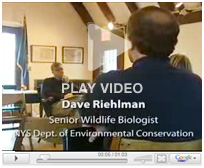 |
DEC representative says they don't get involved in recommending deer numbers.
a |
|
Kate Supron, Chair of DRAC, stated at one meeting that, "We have too many deer, approximately three times the amount the DEC recommends."34 In the Cayuga Heights Courier, she wrote, "The number of deer is more than double the NYS Department of Environmental Conservation's recommended population for a Village the size of ours."35
Mayor Gilmore has reinforced this fallacy, saying that he recommends killing deer to bring "the numbers within recommended Dept. of Environmental Conservation (DEC) levels."36
Yet, Dave Riehlman, Senior Wildlife Biologist with the DEC, told DRAC members, "As far as the number of deer you want around... we pretty much defer to you. It's your community. How many deer or what level of impacts do you want? And so we aren't going to get involved in the process where we say, you ought to have 35 deer per square mile here, no more, no less."37
Faulty reasoning: The decision to carry out a bait-and-shoot program in Cayuga Heights is only of concern to those living within the Village limits.
DRAC Chairperson Kate Supron has said, "This cannot be done without overwhelming support of the
 |
In a community as geographically interconnected as ours, whose decision should it be?
|
|
residents in the area where the program is to be implemented. And I say the residents because I think we need to be given the respect as a village to make this decision for ourselves...they live in our community, they're affecting our lives, and the state of New York gives us the legal authority to make the decision on what to do with the deer."38
However, the Village of Cayuga Heights, with a total area of only 1.4 square miles, is completely embedded within several other densely populated municipalities. Neither deer, nor the bullets that will be used to kill them, recognize the municipal boundaries drawn on a map. The fact is, thousands of people travel, study, work, shop, recreate, and reside in neighborhoods within firearm range of any location within Cayuga Heights. Does it make sense to consider imposing a serious risk on these citizens without disclosure, and without seeking their consent? (Click here to see if you are within range of a stray bullet)
Exaggeration: To bolster DRAC's assertion that deer can become aggressive and therefore pose a threat to public safety, an example is given of a man in California who died of wounds inflicted by a deer.
 |
A tragic encounter with wildlife is mischaracterized as an example of deer-human aggression. |
|
"My third point, human-deer aggressive interactions. This sounds kind of silly, but explain that to Ron Dudek of Rancho Santa Fe, Calilfornia. He died of complications inflicted to his face by a deer in his backyard garden."39
--DRAC member John Hermanson
"There was no sign of aggression," said Steve Martarano of the California Dept. of Fish and Game, commenting on the Ron Dudek case. "This was a startled deer that tried to get out any way it can and ended up hooking the victim"40
Commenting on the Ron Dudek case, Larry Hawkins of the USDA said that nationwide, deer attacks are rare.41
Contradiction: Citing as evidence numerous examples of how deer failed to react aggressively in response to her own aggressive actions toward them, the Chair of DRAC makes the case that the deer in our area pose a threat to public safety.
 |
Kate Supron's examples demonstrate aggression on her part, but prove nothing about aggression in deer.
a
|
|
"When you open your door in Cayuga Heights and walk out and yell at the deer, nothing happens. If you pick up a rock and throw it at the deer, nothing happens. If you hit them, they sort of turn and look at you. Diane and I are both runners and we go out and run in the early morning, and you come right up on a deer, and they don't move. If you're on a trail running, and you come upon a deer, it doesn't move. It advances toward you, and it's really frightening. I mean, I haven't had a deer charge me, but I could see that happening. I mean, they're scary, large animals."42
Contradiction: DRAC members invoke the potential danger posed by deer infected with Chronic Wasting Disease*, which is similar to Mad Cow Disease, and is potentially transmissable to humans through the consumption of meat from an infected animal. Yet they repeatedly extol the public service a bait and shoot program would provide by supplying deer meat to area food banks.
* Note: there have only been two cases of CWD found amongst NY State's wild deer population.
 |
If Chronic Wasting Disease is one of the concerns motivating a bait and shoot program, why is DRAC proposing the deer meat be given to food banks? |
|
"Future Committee and Village administration efforts will seek to improve overall safety and quality of life issues in connection with resolving the deer problem. These include vehicular safety/deer collisions, citizens and pets interacting with bucks during the rut or does protecting fawns, threat of lyme disease and chronic wasting disease... We propose that the primary means of decreasing the deer population will be culling the herd...We intend to distribute the venison to food pantries."
--Statement to Village Trustees, read by Deputy Mayor and DRAC member David Donner43
"We have concerns about Chronic Wasting Disease, a huge problem in Michigan. It has touched New York briefly. We believe it has been eradicated, but we need to research this. This is a prion-based disease, we don't know much about this, but you use the word 'Mad Cow Disease' and people start to pay attention." --DRAC member John Hermanson44
"I don't think it's a reason to shoot the deer -- that it could help alleviate hunger in our area -- but it's certainly a nice byproduct of a bait-and-shoot program that that meat would be used in its entirety by the Southern Tier Food Bank." --DRAC Chairperson Kate Supron45
Contradiction: While one of DRAC's stated reasons for advocating the killing of deer is the risk they pose to drivers in Cayuga Heights, the committee's members have not seriously entertained any other approaches to reducing deer-car collisions, including those with a proven track record, such as deer fencing and roadside reflector technologies.
DRAC member Mike Mangione seemed concerned about driver safety when he said, "We just had an
 |
What does it mean when the same person who emphasizes the seriousness of a safety issue rejects a practical solution for reasons of aesthetics?
|
|
article in the newspaper -- I should've torn it out, neglected to do so -- about a woman who was following behind a truck that hit a deer, and she said it was within seconds of her hitting it, and I believe it was on Route 13. And she was very concerned about, you know, the deer that cross there and so forth. And I believe that is still part of Cayuga Heights."
Yet, in the same meeting, his comments on a proposal for implementing non-lethal approaches to alleviating deer-human conflicts revealed other concerns: "Thinking about this idea about some sort of reflector, the only thing I can think of is, I don't think I want that in front of my house."
Just moments later, he again rejected these proven safety devices for aesthetic reasons, saying, "As far as reflectors and things of that nature, you know, when we talk about the beauty of our village, I'm not sure we want something like that."46
Exaggeration and faulty reasoning: DRAC has listed the "threat of Lyme disease" as one of the justifications for the committee's support of a deer killing program.47
With a rate of infection averaging 3.3 per 100,000 people, the incidence of Lyme Disease in Tompkins county is low compared to many other counties in New York state. For example, the state's average infection rate is 26.2 per 100,000, and some counties in the Hudson Valley and Long Island see hundreds of cases of Lyme Disease per 100,000 residents.48 Of the few cases of Lyme disease seen in Tompkins county, it is believed that at least some of the them were contracted by people while traveling to areas where the incidence of the disease is much higher.
However, regardless of the rate of infection, it's important to understand that people don’t catch Lyme disease from deer. It is ticks that transmit the disease to humans. So, if our community is serious about lowering our already comparatively low rate of this disease, does it make sense to kill lots of deer? While it is true that deer and other large mammals play a part in the reproductive cycle of deer ticks, who feed on them before laying their eggs, most cases where killing deer has been shown to be effective in significantly reducing tick populations have been on islands and peninsulas where it was possible to carry the killing to the extent of near eradication.49
To learn about more effective strategies for reducing the risk of Lyme disease, click here.
Exaggeration: The Chair of DRAC asserts that local vets are now recommending companion animals be vaccinated for Lyme disease.
"I know that Lyme disease is increasing in prominence, certainly in the pet population. Local vets are now recommending vaccinating all the house pets against Lyme disease because it is moving into our area." --Kate Supron, DRAC Chairperson50
Both Cornell University Companion Animal Hospital and the largest local private vet hospital in our area do not make recommendations that people give their dogs, cats and other companion animals vaccinations for Lyme disease. Cornell only administers the vaccine to those who specifically request it for their animals, and the private vet hospital doesn't even keep the vaccine in stock.51 So, while it is possible there are local vets who will recommend vaccinating companion animals for Lyme disease, it is not the prevailing sentiment amongst those with the most veterinary expertise in our region.
Exaggeration: DRAC members have invoked the public health risk of contact with deer feces, yet there is no evidence to support this claim.
"I also have concerns that we'll explore about exposure to parasites, which might be encountered if your kids are in the back yard and they're hanging around with deer feces."
 |
DRAC members claim deer feces pose a health risk in our community, though there is no evidence this is true. |
|
--DRAC member John Hermanson52
"...there are children all over this village who play outside, and for heaven sakes, I'm not gonna tell my kids they can't play outside. I have a neighbor behind me who says they shouldn't be allowed to go on the grass, and her children aren't. That's not how I'm raising my kids... but when it rains and it dissolves, and they dig in the dirt, I don't think it's -- you know, I think kids should be allowed to play outside. And I think if it reaches the point where children can't play outside without wearing gloves, we're ignoring -- we're not trying to address the problem." --DRAC Chairperson Kate Supron53
When contacted and asked about this issue, a representative of the Tompkins County Health Department stated that she had never heard of
deer feces being raised as a public health issue, nor of anyone in our county becoming ill as a result of contact with deer feces.
This web site is published by CayugaDeer.org - Ithacans for Safe, Ethical, and Rational Approaches to Reducing Deer-Human Conflict. We are a group of concerned citizens from Ithaca neighborhoods, including Cayuga Heights. If you would like to join our educational outreach effort and be informed of opportunities where your input can make a difference, contact us.
References:
|
|